
Lavender Macarons with Vanilla Buttercream

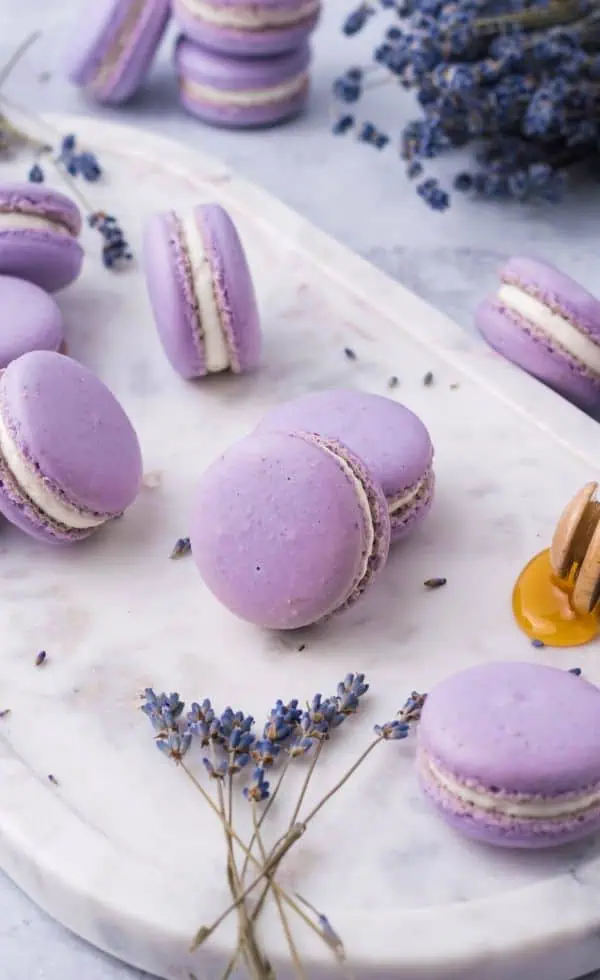
These lavender macarons are one of those recipes that looks intimidating from the outside but is completely within reach once you understand a few key techniques. We are talking about delicate, smooth shells with a gentle floral note from real culinary lavender, sandwiched around a creamy honey vanilla buttercream that balances the floral flavor perfectly. They look like something you would find in a Parisian bakery window, and you are going to make them in your own kitchen.
The thing most home bakers do not realize is that macarons are less about talent and more about technique and patience. Once you nail the macaronage (that is the French term for folding your almond flour mixture into the meringue), everything else clicks into place. I ground the lavender extra fine so it blends seamlessly into the batter, and I kept the color a soft purple so these look as dreamy as they taste. If you enjoy floral bakes like these, my Earl Grey Macarons use the same shell technique and are another beautiful variation worth trying.

Recipe Snapshot
- Elegant Bakery-Style Treat: These lavender macarons have delicate floral flavor, crisp chewy shells, and creamy vanilla buttercream filling that feels straight from a French pastry shop.
- Lightly Floral Without Tasting Overpowering: Culinary lavender adds a soft aromatic flavor that stays balanced and subtle instead of becoming overly perfumey or soapy.
- Perfect Make-Ahead Dessert: Macarons actually improve after resting in the refrigerator overnight, allowing the shells to soften slightly while the flavors fully develop.
- Best For: Tea parties, bridal showers, baby showers, spring dessert tables, edible gifts, elegant holiday baking, and weekend baking projects that feel extra special.
David’s Tip: Grind the lavender buds extra fine before adding them to the batter. Larger lavender pieces can create uneven shells and sometimes overpower the delicate flavor balance that makes lavender macarons taste elegant instead of overly floral.

What really makes these special is that they are naturally gluten-free, make-ahead friendly, and completely giftable. Pop them in a little box tied with ribbon and you have one of the most impressive homemade gifts anyone could receive. They are perfect for bridal showers, Mother’s Day, tea parties, or any day you feel like making something pretty.
Why You’ll Love These Lavender Macarons

The Ingredient Breakdown
For the Lavender Macaron Shells
For the Vanilla Buttercream Filling
Top Tip for a “Fabulous” Smooth Shell
For that perfectly smooth, “eggshell” finish, you must sift your dry ingredients twice. Even “fine” almond flour can have larger bits that will create bumps on your shells. Sift the almond flour and powdered sugar once, then pulse them in a food processor with the lavender buds for one minute, and sift again. Discard those final coarse bits—your smooth tops will thank you!

How to Make Lavender Macarons (Step-by-Step)
Step 1: Process and Sift the Dry Ingredients
Add your sifted almond flour, powdered sugar, and dried lavender buds to a food processor and pulse for about one minute. You want everything ground to the same fine consistency so the lavender essentially disappears into the mixture. Sift this processed mixture through a fine mesh sieve into a clean bowl. Discard anything that does not pass through. This step is the single biggest thing you can do for smooth, professional-looking shells.
Step 2: Whip the Meringue to Stiff Peaks
Add your egg whites and cream of tartar to the bowl of a stand mixer fitted with the whisk attachment. Beat on medium speed until the whites are foamy and just beginning to hold soft peaks. With the mixer running, gradually add in the granulated sugar one slow pour at a time. Do not dump it in all at once. Increase the speed to high and beat until you have stiff, glossy peaks that stand straight up without drooping when you lift the whisk. Add a tiny amount of purple gel food coloring and beat just until incorporated.

David’s Tip
The meringue is ready when it sticks straight up on the whisk and the bowl can be turned upside down without anything moving. It should look glossy and feel smooth between your fingers. If it looks dull or grainy, the sugar did not dissolve fully and you need to keep whipping.
Step 3: Macaronage — Fold the Batter
Sift half of the almond flour mixture into the meringue. Using a wide rubber spatula, fold by going around the outside edge of the bowl and then cutting straight through the center. Continue until there are no dry streaks remaining. Sift in the remaining almond mixture and continue folding. You are looking for a lava-like consistency where the batter flows slowly off the spatula in a thick, continuous ribbon. Draw a figure eight with the falling batter. It should hold its shape briefly then melt back into the bowl within 15 to 20 seconds. If it disappears in under 10 seconds, your batter is over-mixed.
Step 4: Pipe and Rest
Fit a piping bag with a large round tip and fill it with the macaron batter. Line two baking sheets with silicone mats or parchment paper. Pipe circles of about one and a half inches in diameter, holding the tip straight down and releasing pressure cleanly at the end. Tap the baking sheets firmly on the counter several times to release any air bubbles. Use a toothpick to pop any bubbles that rise to the surface. If your shells have little peaks on top, lightly dampen your fingertip and press them gently flat. Allow the piped shells to rest at room temperature for 20 to 30 minutes, or until the surface looks matte and completely dry to the touch.
Step 5: Bake
Preheat your oven to 300 degrees F. Bake the shells for 14 to 15 minutes. You will know they are done when the tops do not wobble when you gently nudge them and you can see the little ruffled feet around the base of each shell. Do not open the oven door during baking. Remove from the oven and let the shells cool completely on the pan before attempting to peel them off. They will release cleanly once fully cool.
Step 6: Make the Honey Vanilla Buttercream
Beat the softened butter in a stand mixer on medium until smooth and creamy, about two minutes. Add the honey and mix until fully combined. Add the powdered sugar one cup at a time, mixing fully after each addition and scraping down the sides of the bowl as you go. Add the heavy whipping cream and slowly increase the speed to high. Whip for two to three minutes until the buttercream is light, fluffy, and holds its shape when piped. Transfer to a piping bag fitted with a round tip.
Step 7: Fill and Mature
Match up your shells by size. Flip half of them over and pipe a small mound of buttercream in the center of each one. Gently press the matching shell on top, applying even pressure from the center outward so the filling spreads to the edges without overflowing. Place the filled macarons in an airtight container and refrigerate for at least 12 hours, ideally 24 hours. This resting period is what gives you that signature chewy texture and melds the filling into the shell. Bring them to room temperature for 20 to 30 minutes before serving.

Make it Your Own with These Variations
Lavender lemon. Add a teaspoon of finely grated lemon zest to the dry mixture before sifting, and stir a tablespoon of fresh lemon juice into the buttercream. The citrus cuts through the floral note beautifully.
White chocolate ganache filling. Melt three ounces of good white chocolate with two tablespoons of heavy cream. Chill until firm enough to pipe. Rich, silky, and stunning against the lavender shell.
Tea party lemon curd center. Pipe a ring of buttercream around the outside of the shell and fill the center with a small dollop of lemon curd. Unexpected and incredible.
Color play. Keep the shells a very pale natural lavender for a subtle look, or go deeper purple for a bold, dramatic effect. Both are stunning on a dessert table.
Storage & Make-Ahead Instructions
Refrigerator: Store filled macarons in an airtight container in the fridge for up to four days. They are at their absolute best on days two and three after filling, once the shells have softened and the flavors have fully melded together.
Freezer (unfilled shells): Baked, unfilled macaron shells freeze beautifully for up to two months. Layer them between sheets of parchment paper in an airtight container. Thaw in the fridge overnight, then fill and allow to mature as usual.
Freezer (filled): You can freeze filled macarons, though high-moisture fillings like lemon curd can soften the shells slightly upon thawing. Buttercream-filled macarons freeze well for up to one month. Thaw overnight in the fridge.
Make-Ahead Tip: Bake and fill the macarons the day before your event, refrigerate overnight, and bring them to room temperature about 20 to 30 minutes before serving. They will be at peak texture and flavor.
These lavender macarons are one of those recipes that feels like a real accomplishment every single time you make them. The first time you pull a tray from the oven and see those perfect little feet, you are going to feel so proud of yourself. That is my favorite kind of recipe. One that teaches you something and rewards you with something gorgeous at the end.
If you make these, I want to hear about it. Leave a comment below and tell me how they turned out. Did you add a twist to the filling? Did you gift them to someone? Drop it all in the comments. And if you share them on social media, tag me so I can see your beautiful work. Happy baking, everyone.
More Beautiful Cookies & Sweet Treats to Try
- Easy Double Chocolate Cookies
- Coffee House Cookies
- Peanut Butter Blossom Cookies
- Pumpkin Spice Chocolate Chip Cookies
- Homemade Oatmeal Cream Pies
- Chai Sugar Cookies
- Reeses Pieces Chocolate Chip Cookies

Lavender Macarons with Vanilla Buttercream
Ingredients
- 70 grams almond flour Sifted
- 63 grams powdered sugar
- 3 teaspoons food grade dried lavender buds
- 55 grams egg whites
- ¼ teaspoon cream of tartar
- 55 grams granulated sugar
- Purple GEL food color optional
- 1 stick butter- softened
- 2 cups powdered sugar
- 2 Tablespoons honey
- 2 Tablespoons heavy whipping cream
Instructions
- Add sifted almond flour, powdered sugar, and lavender buds into a food processor and pulse for about 1 minute. Set aside for now.
- In the bowl of a stand mixer, add egg whites and cream of tarter and whisk until bubbly. GRADUALLY add in the granulated sugar and mix until soft peaks form. Add in purple food color and mix on high speed until stiff peaks form. The meringue should stick straight up when you remove the whisk.
- Sift half of the almond mixture into the meringue and fold by going around the bowl and straight through the center of the meringue. Continue folding until there are no dry spots remaining.
- Sift in the remaining almond mixture and fold until you get a “lava-like” consistency. You should be able to pick up your spatula and draw a figure 8 with the batter without it breaking off. The batter should also disappear back into the bulk after about 15-20 seconds.
- Prepare a piping bag with a large round tip. Use a large mug or glass to hold the piping bag while you fill with the macaron batter.
- Add a silicon mat or parchment paper to a baking sheet. Pipe about 1 ½” circles (I recommend using a template, you can easily find one on google images) of batter then tap the baking sheet against the counter to remove and air bubbles. Use a toothpick to pop any air bubbles that come to the surface. TIP: If there are little “nipples” that stay on the top of the shells, wet your finger and gently press those into the shell to smooth the top.
- Allow the shells to set for 20-30 minutes or until a “skin” forms on the outside. You should be able to touch the top of the shells without batter coming off on your finger.
- Bake at 300 degrees. F for 14-15 minutes or until you can touch the top of the shell and it does not move around on the “feet”.
- Remove form the oven and allow to cool COMPLETELY before trying to remove them from the pan.
- While they are cooling, prepare the honey buttercream by adding the butter into the bowl of a stand mixer and cream until nice and smooth. Add in honey and mix until well combined.
- Add in powdered sugar one cup at a time and fully incorporate. Last, add in heavy whipping cream and slowly increase speed to high and whip for 2-3 minutes until you get a whipped consistency. Add to a piping bag with a large round piping tip.
- Flip over half of the shells and pipe a small amount of buttercream on each shell and top with the remaining shells.
- Place in an airtight container in the refrigerator for at least 24 hours to “mature” this will give you the best results. Bring the macarons to room temperature and serve!
Nutrition
Notes
-
- Parchment Paper or Silpat Mats to prevent these delicate cookies from sticking.
-
- Heatproof Bowl you’ll need this to make the perfect meringue.
-
- Two Large Sheet Pans to bake the macarons on.
-
- Piping Bags help make perfectly shaped and sized Lavender Macarons.
-
- Small Sauce Pan to heat your batter to the perfect temperature.
-
- Stand Mixer This isn’t essential but you’ll be thankful you have it because whipping your meringue can be quite the workout by hand.
-
- Rubber Spatula helps you scrape the sides of the bowl to get every last delicious bit out.
-
- Fine Mesh Sieve You’ll want to keep any big clumps or pieces of almond flour out for the perfect macaron texture.
Tried this recipe?
Let us know how it was!FAQs: Macaron Questions, Answered
Why did my macarons crack on top?
Cracked shells almost always mean the shells did not rest long enough before baking and did not form a proper skin, or the oven temperature was too high. Make sure the tops are completely matte and dry to the touch before putting them in the oven, and always verify your oven temperature with a thermometer. Even a 10-degree difference matters with macarons.
Why do my macarons not have feet?
Feet form when the skin on the top of the shell forces the batter to rise outward instead of upward. If you are not getting feet, the shells likely did not rest long enough, the meringue was under-whipped, or the oven temperature is too low. Make sure your meringue reaches stiff, glossy peaks before folding, and give those shells a full 30 minutes to form their skin.
Can I use fresh lavender instead of dried?
Stick with dried culinary lavender for this recipe. Fresh lavender has too much moisture and the flavor intensity is unpredictable, which can throw off both the batter texture and the final taste. Food-grade dried lavender buds are easy to find online or at specialty grocery stores and give you consistent, reliable results every time.
Why are my macaron shells hollow inside?
Hollow shells usually come from over-whipped meringue, over-mixed batter, or baking at too high a temperature. The goal is stiff but not dry meringue, batter that flows like lava rather than running like water, and a steady 300 degrees F oven. An oven thermometer is your best friend here.
How do I know when the batter is mixed enough during macaronage?
The batter is ready when it falls from your spatula in a slow, thick, continuous ribbon. Pick up a scoop and let it fall back into the bowl. If you can draw a figure eight with the falling batter without it breaking and the ribbon melts back into the bowl within 15 to 20 seconds, you are there. If it disappears in under 10 seconds, the batter is over-mixed and the shells will spread too flat.
Do I have to refrigerate them for 24 hours before eating?
You do not have to, but the 12 to 24 hour rest is genuinely what separates a good macaron from a great one. Freshly filled macarons have shells that are still slightly crisp and a filling that has not fully set. After resting, the moisture from the filling transfers into the shell and creates that signature chewy texture. Trust the process and refrigerate them overnight.
Can I make these without a stand mixer?
You can use a hand mixer to whip the meringue, but it will take significantly longer and requires a steady hand. A stand mixer makes the process much easier and more consistent. If you are using a hand mixer, make sure your bowl is completely grease-free and give yourself extra time to reach those stiff, glossy peaks.
